





AI-centric keyword strategy ranks keywords by AI Vulnerability—how easily an AI Overview or chatbot can answer a query without sending a click. It reduces spend on broad informational queries and reallocates budget to Commercial, Transactional, and Verification-driven keywords where users still require human proof before purchasing.
What Is AI-Centric Keyword Research?
AI-Centric Keyword Research is a filtering system that evaluates keywords based on:
AI Answerability (whether an AI Overview fully satisfies the query)
Intent Strength (commercial investigation or transaction likelihood)
Verification Demand (the amount of detail users must confirm on a website)
Unlike legacy keyword research—which prioritizes search volume—this model optimizes for survival in zero-click environments.
The Counter-Narrative
Most SEO playbooks still treat volume as a predictor of ROI. In 2025, this is misleading because AI Overviews suppress clicks on high-volume informational terms by 30–50%. Traffic volume is no longer a proxy for revenue.
Key Takeaways
Risk: Informational traffic is collapsing. AI Overviews answer broad questions instantly, cutting clicks by 30–50%.
Pivot: Stop funding “definition” content. Reinvest into commercial, comparison, and experience-backed assets.
ROI: Commercial-intent keywords often show 3–5× higher conversion rates, even at lower volume, because users must verify details before buying.
Outcome: Success shifts from “ranking” to “being cited by AI models.”
The “Table of Truth”: Legacy SEO vs. AI-Ready SEO
Feature | Legacy SEO (Old) | AI-Ready SEO (New) |
|---|---|---|
Primary Metric | Total traffic volume | Click-through survival + revenue impact |
Content Focus | “What is X?” guides | Comparisons, teardown reports, real decisions |
Keyword Selection | Broad, high-volume | Long-tail, narrow intent |
Success Signal | Ranking #1 | Cited inside AI Overview / chosen as a source |
Risk Profile | Low (traffic easy to win) | High (AI captures informational queries) |
The Counter-Narrative
The dominant industry assumption is that publishing more content increases surface area and offsets AI losses. Data shows the opposite: 30%+ of content now produces zero search clicks, and adding more weak pages lowers domain efficiency.
The Trap: Why High-Volume Keywords Are Now a Liability
High-volume terms—e.g., “project management software” with 100k+ monthly searches—once justified long guides and link-building budgets.
The Core Failure Mode
AI models are trained on these exact guides.
User asks “What is project management software?”
AI provides a complete summary.
Zero click. You paid; AI captured the value.
Action for Your Team
Pause production on keywords beginning with:
“What is…”
“Definition of…”
“History of…”
“Beginner guide to…”
These are structurally high-risk, low-return categories.
The Counter-Narrative
Many SEO teams still treat high-volume as “low-hanging fruit.” In 2025, this fruit is already eaten by AI. Pursuing volume creates phantom traffic projections that never materialize.
The Solution: Build a Verification-Driven Content Layer
AI excels at generating lists and summaries but struggles with verification, recency, context, and experience.
That gap is now your competitive moat.
Target These Keyword Classes
1. Comparison Keywords
Example: “Salesforce vs HubSpot for 20-person teams”
AI cannot generalize accurately across specific business constraints.
2. Data Keywords
Example: “CRM pricing comparison table 2025”
AI’s pricing data often lags; humans click to confirm accuracy.
3. Experience Keywords
Example: “Why we switched from Asana to ClickUp”
AI cannot fabricate credible experience without risking hallucination.
4. Failure Mode Keywords
Example: “We tried X and it broke at 2,000 users”
Real operational failures outperform AI-generated generalities.
The Counter-Narrative
Most content teams invest in “how-to” guides because they are easy to scale. But AI generates unlimited how-to content instantly. What AI cannot generate reliably is evidence, benchmarks, screenshots, and operational quirks.
Those signals now drive conversion.
The Counter-Narrative: Why We Reject the “Publish More Content” Advice
Industry guidance still claims “you must out-publish AI.”
This logic is fundamentally flawed.
Why “More Content” Fails in 2025
AI training data rewards depth, not volume.
Most “more content” is duplicate intent, lowering quality signals.
Only unique data, tests, and verified workflows survive inside AI Overviews.
Strategic Reallocation
Shift budget from:
60% copywriting → 30% copywriting + 30% data gathering + 40% visual evidence
Examples of high-ROI assets:
Performance benchmarks
Pricing tables
Tool comparisons
Real-world case studies
Screenshot-rich walkthroughs
Latency tests, uptime tests, integration tests
These assets feed both human trust and AI citations.
Next Steps for Your SEO and Content Team
Step 1 — Export Your Keyword List
Include historical rankings, CTRs, and attribution.
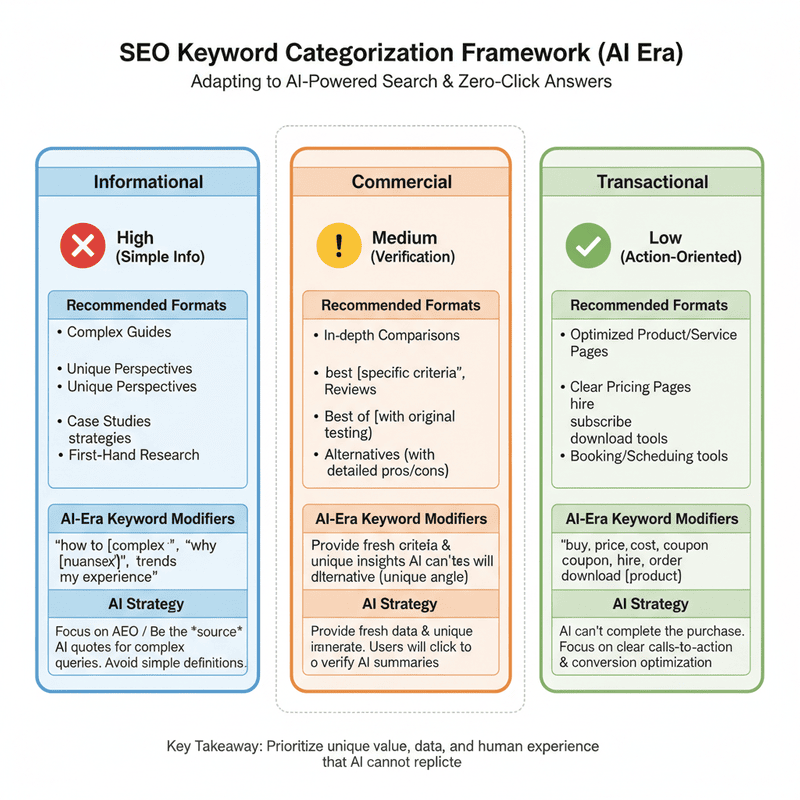
Step 2 — Label Each Keyword by Intent
Informational (High Risk)
Commercial Investigation (Safe)
Transactional (Very Safe)
Step 3 — Deprioritize High-Risk Informational Terms
If AI Overviews already dominate the SERP, remove these from active production.
Step 4 — Build New Assets Around Verification
High-value formats include:
Product comparison charts
Year-over-year pricing tables
“Why we switched” narratives
Implementation reviews
API or UX teardown analysis
Step 5 — Optimize for AI Citation
Use:
Clear subheadings
Schema markup
Structured lists
Original data visualizations
These improve your odds of being quoted inside AI Overviews and chat-based answer engines.
FAQs
Will AI kill SEO completely?
No. AI replaces fact-retrieval queries (encyclopedia function) but not commercial navigation. Users still click for pricing, screenshots, configuration details, and verification before buying.
How do I know which keywords are safe?
Search your target keyword.
If an AI Overview answers fully and occupies the entire screen → High-risk.
If AI provides only a partial summary and links out for detail → Safe for investment.
Table of contents

About the author