




After analyzing thousands of high-converting posts across every platform (and honestly, way too many that flopped despite being pure gold content-wise), I've discovered the brutal truth: most creators treat CTAs like an afterthought. They spend 90% of their energy on the content and slap on a generic "follow for more" like it's going to magically transform browsers into buyers.
Your CTA isn't just the end of your post.
It's the bridge between inspiration and action. And if you're not building that bridge intentionally, you're leaving money and connections on the table. Just like we covered with headlines that stop the scroll, your CTA needs to work as hard as every other element of your content.
Key Takeaways
Your CTA placement matters more than your CTA copy
Every extra step between intention and completion costs you 50% of potential takers.
The "soft ask" often outperforms the "hard sell"
Context trumps creativity
The biggest mistake I see creators make is treating every CTA the same way. They use "link in bio" for everything from free resources to paid courses, expecting their audience to figure out the value proposition and navigate multiple steps to get there.
Your audience is scrolling on their phone, probably multitasking, definitely not in "research mode." If your CTA requires them to remember something, navigate somewhere else, or make a decision about multiple options, you've already lost most of them.
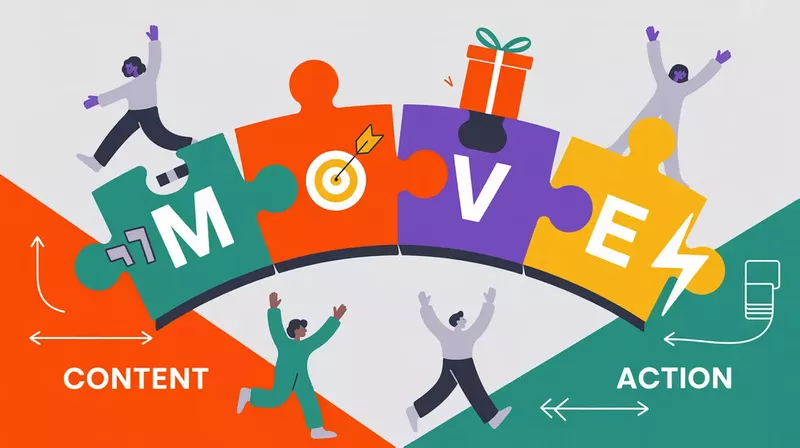
How to Write CTAs Using the MOVE Framework
Here's the MOVE framework that consistently outperforms traditional calls-to-action:
M - Micro-Commitment
Start with the smallest possible yes. Instead of "Subscribe to my newsletter for weekly tips," try
Reply with your biggest content struggle.
The first asks for ongoing commitment; the second asks for one simple action.
The psychology here is commitment escalation. Once someone takes a small action, they're more likely to take progressively larger ones. Think of it like warming up before exercise, you don't start with the heavy weights.
O - Outcome-Focused Language
Your CTA should focus on what they get, not what they give. Instead of "Subscribe to my newsletter," try
Get weekly strategies that actually work.
The first asks for their attention; the second promises transformation.
Use "you" language and present tense: "You'll discover..." rather than "I'll teach you..." It makes the benefit feel immediate and personal.
V - Value-First Positioning
Lead with what you're giving before asking for what you want.
I'm sharing my exact client onboarding template, DM me 'TEMPLATE' to get it
feels generous.
"DM me for my template" feels transactional.
This flips the traditional sales equation. Instead of asking them to invest (time, email, attention) to maybe get value, you're promising value upfront in exchange for a simple action.
E - Effortless Execution
Make the action so simple they could do it by accident.
Double-tap if this resonated
is more effortless than "save this post for later." Both show engagement, but one requires zero cognitive load.
The best CTAs can be completed without leaving the platform, making decisions, or remembering information. Every additional step cuts your completion rate roughly in half.
How to Avoid the 5 CTA Mistakes That Kill Conversions
Mistake | Fix | |
|---|---|---|
Mistake 1 | The Generic Template Trap "Link in bio," "Follow for more," "DM me" these phrases have become background noise. Your brain literally filters them out. | Be specific. Instead of "Follow for more content like this," try "Follow if you want weekly behind-the-scenes breakdowns of what's actually working." |
Mistake 2 | The Multiple Choice Disaster Like this post, save it for later, share it with a friend, and check out my other content" creates decision paralysis. | Pick one primary action per post. You can have secondary CTAs, but make it obvious which one matters most. |
Mistake 3 | The Value Assumption Error Just because you delivered value doesn't mean people automatically see the connection between that value and your CTA. | Bridge the gap explicitly: "If strategies like this one are helpful, you'll love my weekly newsletter where I break down exactly how to implement them." |
Mistake 4 | The Friction Overload Count every step between your CTA and completion. Each step loses people. | Reduce steps without reducing value. "DM me 'GUIDE'" is better than "click the link in my bio to access my free training portal where you can choose from 12 different resources." |
Mistake 5 | The Timing Disaster Asking for action before you've provided enough value, or waiting so long that people have already moved on mentally. | The sweet spot is right after you've delivered a key insight but before the content feels complete. Test different CTA placements — sometimes the middle performs better than the end. |
How to Create Your Personal CTA System That Converts
The most converting CTAs don't feel like CTAs — they feel like natural next steps in an ongoing conversation.
Create 15-20 proven CTAs you can adapt to different content:
Engagement starters: "What's your experience with this?" / "Anyone else relate?" Value deliverers: "Want the template I use?" / "DM me for the full breakdown" Community builders: "Tag someone who needs this" / "Share your results below" Relationship deepeners: "What questions do you have?" / "What should I cover next?"
Before writing any CTA, define:
Context: Where is your audience mentally when they reach your CTA?
Content: What value did you just provide?
Connection: How does your CTA connect that value to their next step?
Example: Content about overcoming impostor syndrome → CTA:
Ready to put these into practice? I've created a daily reflection guide that makes these shifts automatic, DM me 'CONFIDENCE' to get it.
Read your CTA out loud as if you're talking to a friend. If it sounds like something you'd actually say in conversation, it'll probably work.
"Hey, I made a cheat sheet for this stuff, want me to send it to you?" ✓
"Claim your exclusive access to our comprehensive resource library" ✗
Pick one variable and test two versions:
Week 1: "DM me 'GUIDE' for the free resource"
Week 2: "Reply 'GUIDE' for the free resource"
Keep everything else identical. This isolates what's actually causing the performance difference.
The most successful creators systematically test their CTAs. Start with your most recent post, rewrite the CTA using the MOVE framework and watch what happens to your engagement.
Your content can change lives, but only if people actually do something with it. The difference between creators who build audiences and creators who build businesses often comes down to knowing how to turn inspiration into action.
What CTA are you going to test first?
Table of contents

About the author