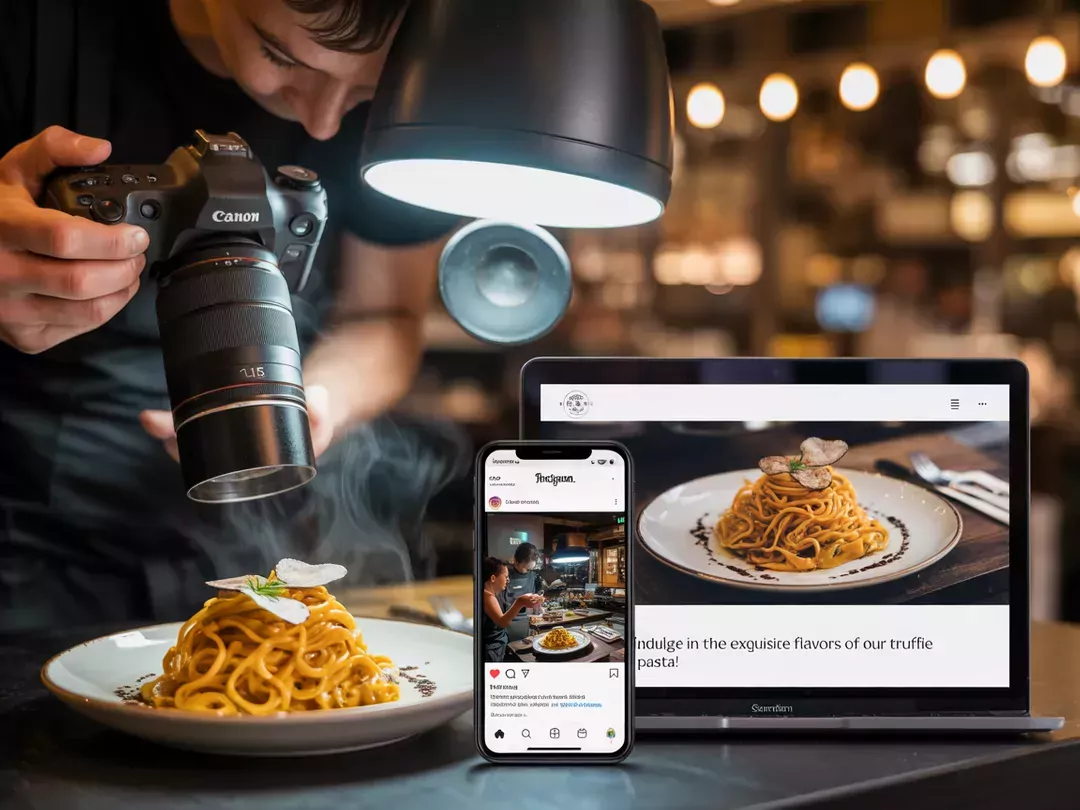
Everyone has decent food photos these days.
Thanks to portrait mode and editing apps, you can make almost any dish look polished. But “pretty” is not enough.
The goal isn’t just to look good, it’s to make people want in.
Craving isn’t triggered by symmetry. It’s triggered by texture, warmth, atmosphere, and emotion. And that’s where most restaurant photos fall short.

This one seems obvious but it’s about more than showing food. You need to tease the senses.
Think glistening sauce, not sterile plates.
Show steam, melting cheese, or a fork mid-scoop.
Let the juice drip. Let the crust crack.
Zoom in on texture — sear marks, bubbles, layers.
Craving comes from imperfection — not from a perfectly centered flat lay.
Visuals don’t just sell food. They sell mood.
Ask yourself:
What is the energy of your brand? Cozy? Vibrant? Elegant? Playful?
Are you a brunch-with-friends spot, or an anniversary-dinner haven?
Is your lighting warm or crisp? Music loud or soft?
Your photo style should reflect that.
A great restaurant photo doesn’t say “here’s what we serve.” It says “here’s what it feels like to be here.”
Static dishes are forgettable. Context creates memory.
Show people the hand stirring, the smile of a barista, the laughter in the background
Show process dough being stretched, flames rising, spices falling
Show moments the cheers, the bites, the birthday candle
When you capture story, you don’t just stop the scroll you make someone say:
I want to be there.
Instagram is the conversation. Your website is the destination.
On Instagram, photos should:
Be optimized for vertical (4:5 or Story ratio)
Be spontaneous, reactive, even raw
Focus on emotion over precision
On your restaurant website, photos should:
Be horizontal or landscape for hero sections
Be professionally curated — clean lighting, intentional composition
Support the story (e.g., “Our Chefs,” “Inside the Kitchen,” “Events”)
Be fast-loading and optimized for retina screens
Tip: Use a consistent filter set or color temperature across both platforms for brand cohesion.
Overly dark and moody shots (unless you’re a speakeasy-style bar)
Every dish shot from the same top-down angle
Too many people-less photos, food needs human context
Generic stock images (nothing kills authenticity faster)
Uploading high-res images without optimization, slow sites = lost bookings
With Nilead’s F&B restaurant website builder, you can:
Upload full image sets with responsive scaling for all devices
Add gallery sections (staff, kitchen, events, customer photos)
Schedule seasonal photo rotations — e.g., holiday specials, spring menu
Use drag-and-drop layouts to align your visual story with copywriting
Auto-optimize for loading speed and retina screens — without needing a designer
This means your feed inspires, and your website converts.
Takeaway
Food photos aren’t just visual candy. They are brand signatures subtle but powerful triggers of trust, taste, and desire.
Show more than what you serve. Show who you are and why it’s worth visiting.