




Table of contents

In today's global marketplace, your website is your most powerful tool for international growth. Speaking your customers' language isn't just a courtesy; it's a cornerstone of effective digital marketing and sales. However, any business owner who has ventured into multilingual websites knows the pain: traditional translation is often slow, expensive, and a logistical nightmare to manage.
Here at Nilead, we saw this as a critical challenge for our clients. How could we empower them to "go global" without the traditional headaches? The answer was AI. But as we discovered, simply "plugging in" an AI translator isn't enough. This is the story of how we tackled the problem, overcame a massive technical hurdle, and built a truly smart translation system.
The Problem: The High Cost of a Global Voice
For years, making a website multilingual involved a cumbersome process:
Exporting Content: Manually copying and pasting text from your website into spreadsheets.
Hiring Translators: Finding, vetting, and managing freelance translators or expensive agencies for each language.
Waiting: The back-and-forth process could take weeks, delaying marketing campaigns and product launches.
Importing & Formatting: Manually pasting the translated content back into the website, often breaking layouts and requiring developer help.
This process is a significant barrier to entry for businesses looking to expand. Our goal was to destroy this barrier. We envisioned a feature where a Nilead user could translate an entire product page, blog post, or even a complex page layout with a single click.
Why Not Just Use Google Translate or a Plugin?
Before building our own solution, we asked the obvious question: "Why not use the tools that already exist?" Many businesses turn to popular options like the Google Translate widget or third-party plugins like Weglot. While these tools are great for certain uses, we found they had critical flaws for businesses serious about their global brand presence.
1. The "Google Translate" approach (Raw Machine Translation)
This is the quickest way to get words in another language on your site, but it comes at a steep price to your brand and visibility.
The SEO Black Hole: The standard Google Translate widget translates content on-the-fly in the user's browser. This means search engines like Google never see the translated text. As far as they're concerned, your site only exists in its original language, giving you zero SEO benefit in international markets.
Lack of Quality Control: It’s a raw, one-size-fits-all translation. There’s no way to edit awkward phrases, correct a term to match your industry's jargon, or maintain a consistent brand voice. A professional brand can quickly look unprofessional.
Poor User Experience: Your global customers are met with a clunky dropdown menu and translations that can often feel robotic and unnatural, which erodes trust.
2. The "Translation Plugin" approach (e.g., Weglot, WPML)
These services are a significant step up, offering better SEO and editing capabilities. They act as a translation management layer on top of your website. However, this "bolt-on" approach has its own set of trade-offs.
It’s Another Subscription: These plugins typically operate on a SaaS model, charging you based on the number of words and languages you need. As your business and content grow, this can become a significant and escalating operational cost.
Performance Overhead: Adding another layer of complex scripts and services on top of your website can, in some cases, impact your page load speed—a critical factor for both user experience and SEO.
Content "Lock-in": Your translations are often stored and managed within the third-party platform. If you decide to switch providers or stop your subscription, migrating or even keeping your translated content can be a complex challenge.
We concluded that while these tools have their place, they didn't offer the deep, seamless integration, performance, and long-term value we wanted for the Nilead platform. Our users needed a solution that was a core feature, not a bolt-on. This conclusion led us to build our own system, where we immediately hit a major technical wall.
The Nilead platform was already designed with global businesses in mind, featuring a deeply integrated system for manual content translation. This gives our users complete control to craft the perfect message in every language. However, we listened to their feedback: even with helper tools like ChatGPT, the process of manually translating and pasting content for dozens of pages was still a major time sink.
The clear next step was AI-powered automation. We evaluated existing tools like the Google Translate widget and third-party plugins, but quickly realized they clashed with our core philosophy. They were "bolt-on" solutions that couldn't offer the seamless, high-performance experience our users deserve. Layering an external service on top felt like a step backward from the native system we had already built.
To truly enhance the platform, we knew this couldn't be just another add-on. It had to be a core feature, not a bolt-on. This commitment to deep integration meant building our own AI translation engine directly into our existing framework. And that’s when we immediately hit a major technical wall.
The Challenge: Hitting the AI's "Memory Limit"
Our first attempt was straightforward. We built a command that would gather all the text on a page—headings, paragraphs, buttons, image descriptions—and send it to a powerful AI model like OpenAI's GPT with the prompt, "Translate this from English to Vietnamese."
It failed. Spectacularly.
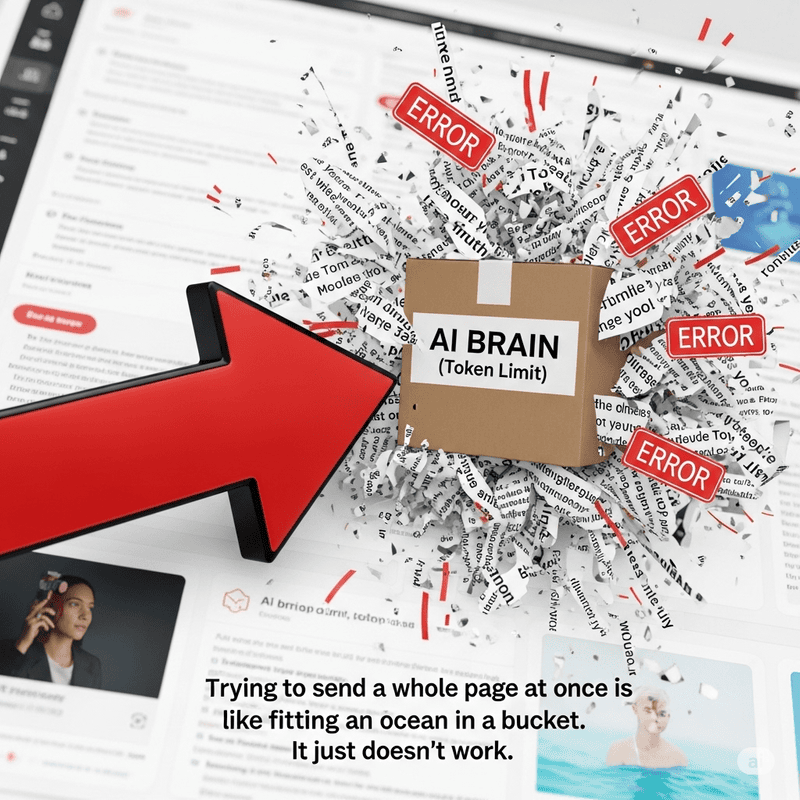
The responses we got back were often incomplete, garbled, or the request would time out. We quickly ran into the single biggest challenge of working with Large Language Models (LLMs): the token limit.
Think of a token limit as the AI's short-term memory. You can't give a translator a 500-page book and expect them to recite it back perfectly after one read. They can only process a few pages at a time. Similarly, an AI can only handle a few thousand words in a single request. Our pages, with all their rich content, were simply too big for the AI's "memory." Sending the whole page at once was like trying to fit an ocean into a bucket.
The Solution: From Brute Force to an Intelligent Agent
We realized we couldn't just send a giant block of text. We needed to be smarter. We needed to act like a project manager, breaking down a big job into small, manageable tasks for our AI worker. This led us to our final, three-tiered strategy.
Step 1: The "Happy Path" - For Small Jobs
First, our system checks the total amount of text. If it's a small job—like translating a simple contact form or a short announcement—it uses the most efficient method: sending all the content in one quick, cost-effective API call. (This is our baseline—fast and cheap for everyday tasks.)
Step 2: The "Medium Path" - Splitting by Field
What if the page has a short title, a few small text blocks, but one massive "product description" field? Sending it all together would fail.
Our system is now smart enough to identify this. It bundles all the small fields together into one efficient API call. Then, it handles the single, oversized "product description" field separately. This avoids an all-or-nothing failure and optimizes the number of requests we need to make.
Step 3: The "Heavy Path" - Intelligent Chunking
This is where the real magic happens. When our system encounters that massive "product description" field, it knows it still can't send it all at once. So, it becomes a "master editor."
It first splits the text into paragraphs. If a paragraph is still too long, it splits it further by sentences. This ensures we are always sending perfectly-sized, semantically complete "chunks" to the AI. The system sends each chunk for translation and, like assembling a puzzle, flawlessly stitches the translated chunks back together in the correct order.
This intelligent chunking means we can reliably translate pages of any length without hitting the AI's memory limit.

The Result: A Resilient, Cost-Effective Translation Engine
By moving from a brute-force approach to this intelligent, tiered strategy, we built a system that is:
Reliable: Token limit errors are a thing of the past. The system automatically adapts to the size of the content, from a single word to a massive landing page.
Cost-Effective: By always trying the "happy path" first and only using more intensive methods when necessary, we minimize the number of API calls, keeping translation costs low for our customers.
Fast: A page that once took weeks to translate with a human agency can now be ready in minutes, allowing our users to launch global campaigns with unprecedented agility.
We even took it a step further by centralizing our "chunking" logic into a shared utility library within the Nilead platform. This means any feature, now or in the future, can benefit from this robust technology, ensuring consistency and efficiency across the board.
This journey is a perfect example of our philosophy at Nilead. We don't just add features; we build intelligent solution
About the author


