Document URL Redirect

URL Redirect

Learn how to set up URL redirects in Nilead to keep your visitors on track and SEO intact when changing your website structure.

Table of content

TL;DR / Overview

URL redirects help you forward users from one page to another, especially when changing page URLs. On Nilead, you can manage redirects easily through the admin interface using either simple or regex-based rules. All redirects apply only to public-facing URLs — backend and API routes are not affected.

Prerequisites

  • You must have access to the Nilead admin dashboard

  • Your website should be live or in staging with frontend access

  • Regex knowledge (only if using advanced redirect rules)

  • Support contact if enabling regex redirection

Walkthrough

Step 1: Access the Redirect Settings

  1. Log in to your Nilead admin dashboard.

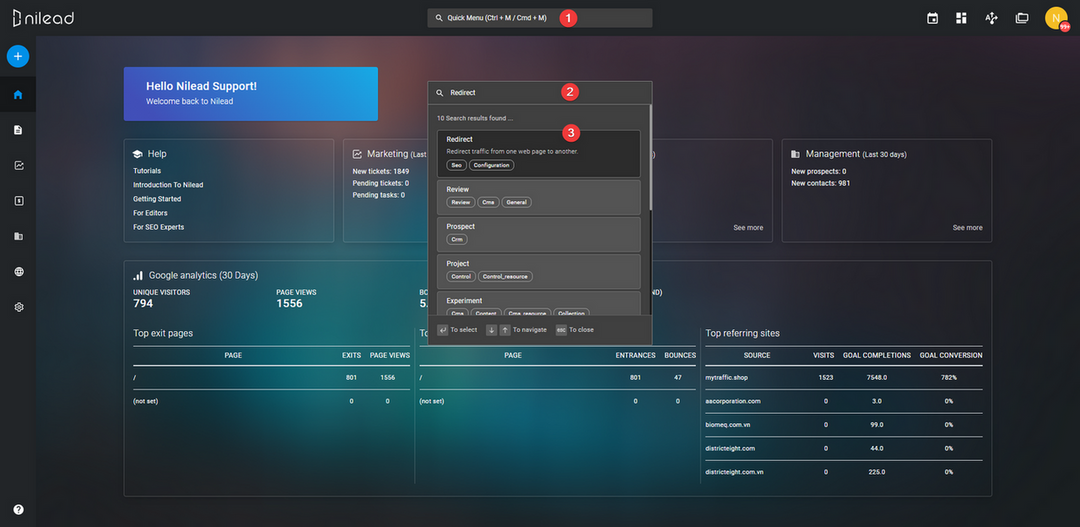
  2. Open the Quick Menu (press / or click the search icon).

  3. Type and select Redirect.

  4. You will be taken to the Redirect Management interface.

quick menu - redirect - Nilead platform

Step 2: Add a New Redirect Rule

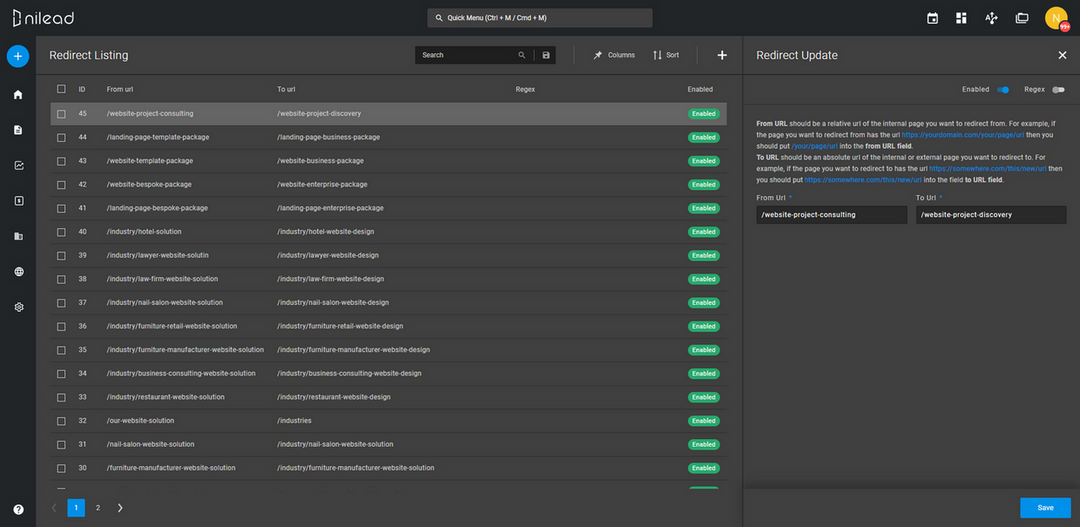
You can create either a normal redirect or a regex-based redirect.

Normal Redirect

Use this when you want to redirect a specific path to another:

  • From: /about-us

  • To: /about

Note: Omit the domain (e.g., don’t include https://yourdomain.com). This makes redirects domain-agnostic and easier to maintain after migrations.

seo - redirect - Nilead platform

Regex Redirect (Advanced)

Use this when you want to redirect a pattern of URLs.

Example: Redirect all /product/xyz URLs to /service/xyz:

  • From: ^/product/(.*)

  • To: /service/${1}

This uses PCRE regex syntax. Internally, preg_match and preg_replace are used to evaluate and apply the rules.

💡 Test your regex at Regex101.com.

Step 3: Enable or Disable a Redirect

Each redirect rule has an Enabled toggle. Use it to temporarily disable a redirect without deleting it.

Step 4: Save Your Changes

Once your redirect is set, click Save. Changes take effect immediately on the frontend.

Note on Regex Performance

Regex redirects are currently disabled by default due to performance concerns. If you need to use them, please contact Nilead Support to enable this feature for your website.

FAQs

1. Do redirects affect my API or admin panel URLs?
No. Redirects only apply to frontend (public) URLs.

2. Can I include the full domain in the redirect?
No. Always use path-only redirects (e.g., /old-page, not https://example.com/old-page).

3. Can I redirect multiple pages using one rule?
Yes, but only using regex. For example, ^/blog/(.*) → /news/${1}.

4. Will redirects affect my SEO?
Proper redirects help preserve SEO when URLs change, especially if you use 301 redirects (Nilead uses this by default).

5. Can I preview the redirect before enabling it?
You can create and disable the rule first, then test manually before toggling it on.

Discord chat

We're available Monday–Friday, security and critical bug fixes are available 24/7.

Facebook page

Get the latest news and updates regarding Nilead platform and services.